Integrated BPM and RPA: The Operating Model Behind High-Performance Digital Operations?
February 18, 2026
RPA at Scale: Why Governance Is the Real Differentiator.
May 12, 2026Integrated BPM and RPA: The Operating Model Behind High-Performance Digital Operations?
February 18, 2026RPA at Scale: Why Governance Is the Real Differentiator.
May 12, 2026Robotic Process Automation
RPA is more than Automation: A Lever for Business Growth and Team Motivation
27/ April/ 2026

Why do we still spend time and budget on tasks that can be automated, executed the same way every time, aligned with business rules, and completed without interruptions? Why assign capable teams to repetitive work that drains motivation and adds little to business growth?
Automation, and increasingly AI, is no longer a trend. It is a practical opportunity for organizations to improve performance, scale operations, and build resilience. But there is an important nuance that often gets overlooked. Digitalization is not a single initiative or a quick technology rollout. It is a journey that requires time, investment, and a clear strategy so it becomes coherent and scalable over time, rather than a collection of fragmented automations that later turn into complexity, risk, and additional cost.
If we want automation to deliver real outcomes, we need to approach it with structure and clarity. That means understanding what we want to improve, why it matters, and how we will govern it. Without that foundation, even the best tools will struggle to deliver value, and the organization will quickly lose trust in automation initiatives.
The real business case: productivity, competitiveness, and talent
In a market where the scarcity of resources and specialized talent is a constant topic, every opportunity to free teams from repetitive work becomes strategic. Repetitive tasks do not just slow down processes. They create hidden costs through delays, errors, rework, and the gradual erosion of motivation.
Automation helps in two ways. First, it improves efficiency and process consistency. Second, it changes the nature of work. When people spend less time copying data, validating fields, reconciling numbers, or triggering the same approvals again and again, they gain time for work that drives growth: customer support, analysis, improvement initiatives, exception handling, decision support, and collaboration with stakeholders.
This is one of the reasons automation is increasingly tied to talent retention. Organizations that remove tedious work and invest in modern ways of working tend to keep teams more engaged, especially when employees are involved in identifying opportunities and shaping the new operating model.
Automation is not a miracle solution. It is not a silver bullet. But when designed and governed correctly, process automation, and RPA in particular, can change the way the business operates. It allows organizations to redirect capacity to what truly matters, strengthen compliance with business rules, and increase reliability in regulated or high risk environments. Optimizing organizational resources in support of strategy is not a technical goal. It is a management imperative.
Automation needs method, not just technology
One of the most common reasons automation programmes disappoint is the assumption that automation equals tools. In reality, automation is a combination of process clarity, ownership, governance, and then technology execution.
Before automating anything, organizations need to answer a few practical questions:
- What is the driving process and what outcomes matter most?
- Where are the bottlenecks, errors, and manual handoffs happening?
- Which steps are stable and rules based, and which steps need human judgement?
- What are the compliance requirements, audit expectations, and security constraints?
- Who owns the process, who maintains it, and how will changes be controlled?
This is why BPM and process management practices matter. They are not bureaucracy. They are the foundation that keeps automation scalable.
What is robotic process automation (RPA)?
Robotic process automation (RPA) is the application of technology to allow organizations to automate routine tasks (e.g., extracting and cleaning data) through existing user interfaces, mimicking human actions. Using RPA, so-called bots are created. (Bots are algorithms that execute automated, usually repetitive tasks.) Because bots utilize existing user interfaces, RPA does not require changes to the core IT systems. By McKinsey
In McKinsey Automation at scale: The benefits for payers [Published: July 2019]
BPM and RPA: the foundation and the engine
Business Process Management (BPM) is often associated with software, but it is broader than that. BPM is a methodology and a culture focused on aligning an organization’s processes with strategic objectives, designing and implementing process architectures, establishing measurement systems, and enabling managers to govern and improve processes over time.
When BPM is applied properly, it creates:
- End to end visibility of how work is done.
- Clear ownership and accountability.
- Standardized process definitions and controls.
- Metrics aligned with business objectives.
- A shared language across teams and departments.
This matters because automation without process clarity leads to “fast chaos”. You automate what exists today, including inefficiencies, exceptions, and undocumented workarounds. You may get speed, but you also scale problems.
A structured approach is more effective:
- Understand and map the process, including systems, roles, and exceptions.
- Simplify and standardize where possible.
- Align the process with business goals, compliance rules, and performance metrics.
- Only then, automate stable and repeatable steps.
- Monitor outcomes and continuously improve.
RPA comes in as the execution engine for tasks that are repetitive, rules based, and high volume. BPM provides the orchestration layer and governance. Together, they create a stronger and more sustainable automation practice.
Market experience consistently shows that automation initiatives are more successful when employees are involved in process design. BPM provides visibility and ownership, while RPA frees teams from manual repetitive work, which supports a more engaged and productive workforce.
What RPA really is, and what it is not
RPA, Robotic Process Automation, is not a physical robot walking around the office. It is software that automates tasks within business and IT processes using scripts or bots that mimic human interactions with application user interfaces.
In practical terms, RPA is highly effective when:
- The task follows clear rules and decision logic.
- Inputs and outputs can be defined and validated.
- The workflow is stable enough to automate without constant redesign.
- There is enough volume to justify automation effort.
- Exceptions can be managed through defined escalation paths.
RPA can interact with different systems, including legacy applications, because it can operate through the user interface. This reduces the need for deep changes to core systems and often speeds up delivery.
At the same time, RPA is not “set and forget”. Automation needs training, testing, monitoring, and maintenance. Interfaces change. Business rules evolve. Exceptions appear. Governance and operational ownership are critical for long term success.
When done properly, the benefits are tangible:
- Faster execution and fewer delays.
- Higher accuracy and consistent outcomes.
- Reduced rework and fewer manual errors.
- Lower operational cost through better capacity allocation.
- Stronger audit trails and traceability.
RPA is especially valuable as part of a broader automation portfolio because it can deliver quick wins while the organization matures toward more advanced forms of automation.
Gartner highlights that RPA remains a core software market for improving efficiency across business processes.
in Gartner Magic Quadrant for Robotic Process Automation [Published: 23 June 2025]
Why RPA matters for business outcomes
Many office employees spend a significant share of their week on repetitive activities such as data entry, routine validations, reconciliations, and standard approvals. These activities typically require minimal creativity or analytical thinking. Automating them does not remove value from people. It increases value by creating space for higher impact work.
RPA also supports digital transformation by making automation accessible across a wide technology stack. Because bots can operate through the user interface, they can interact with almost any application, including systems that are difficult to integrate through APIs. This often reduces the dependency on large development efforts and speeds up automation delivery.
When combined with BPM, RPA becomes more than tactical automation. It becomes a step toward a more controlled and measurable operating model.
The benefits of RPA, in practice
Here is how RPA tends to deliver value when implemented with governance and process clarity:
- Operational efficiency gains: RPA automates repetitive, rules based tasks and reduces cycle times. This improves throughput, stabilizes operations, and frees capacity for improvement initiatives.
- Cost reduction and better allocation of effort: RPA helps reduce operational costs by minimizing manual effort in routine processes. More importantly, it allows staff to be reallocated to work that requires human judgement, customer interaction, or analysis, increasing productivity and ROI.
- Scalability and fast deployment: RPA solutions can scale across departments and processes with relative ease when bots are designed using reusable components and supported by a strong operating model.
- Improved accuracy and consistency: Software bots execute tasks consistently and reduce human error. That consistency is especially valuable in activities with compliance requirements, strict data validation rules, or high financial impact.
- Employee time freed for higher value activities: By removing tedious workloads, teams can focus on strategic, analytical, and creative tasks. This shift often improves motivation and supports retention because people spend more time on meaningful work.
- Enhanced compliance and governance: RPA can produce traceable, auditable execution logs. Combined with BPM governance, it supports stronger risk management, better control of rule execution, and clearer accountability.
- Integration with AI and advanced automation: The market is evolving toward more intelligent automation models that combine RPA with AI capabilities. This enables automation that can handle more variability, unstructured data, and decision support.
RPA, Intelligent Automation, and AI: what is the difference?
These terms are often used interchangeably, but they represent different capabilities and different levels of maturity on the automation journey.
- RPA is process driven and rules based. It follows the logic defined by humans. It does not learn from new information. It executes tasks reliably within defined boundaries.
- Intelligent Automation expands on RPA by combining it with AI capabilities and orchestration, enabling more complex end to end process automation. It can handle unstructured inputs, support exception management, and enable decision support within defined governance rules.
- Artificial Intelligence (AI) is data driven. It can recognize patterns, make predictions, classify information, and generate responses based on training data and models. It includes technologies such as machine learning, natural language processing, and other cognitive capabilities. AI does not replace governance. It requires it, especially when used in operational decision making.
A practical way to look at it is simple:
- RPA executes tasks.
- AI supports understanding and decision support.
- Intelligent Automation combines both to deliver more complete automation outcomes.
Why start now: maturity is a competitive advantage
Organizations that reach higher automation maturity typically combine RPA with process management, analytics, and AI, enabling continuous improvement instead of isolated automation projects.
Starting early matters because automation is not only about technology. It involves skills, operating models, culture, organizational dynamics, and leadership. It is not realistic to implement everything overnight. Teams need time to learn, experiment, measure outcomes, and adjust. Each deployment reduces uncertainty, accelerates the learning curve, and improves the effectiveness of the next step.
Over time, the organization builds reusable automation components, stronger governance, better process ownership, and a clearer view of what should be automated, improved, redesigned, or removed. That maturity becomes a competitive advantage because it improves speed, reliability, compliance, and responsiveness at scale.
Ultimately, all these stages are part of digital transformation and workflow modernization. The goal is simplification, coordination, traceability, monitoring, and stronger operational security, leading to higher performance and better outcomes.
How Governance.Business supports your digital transformation journey
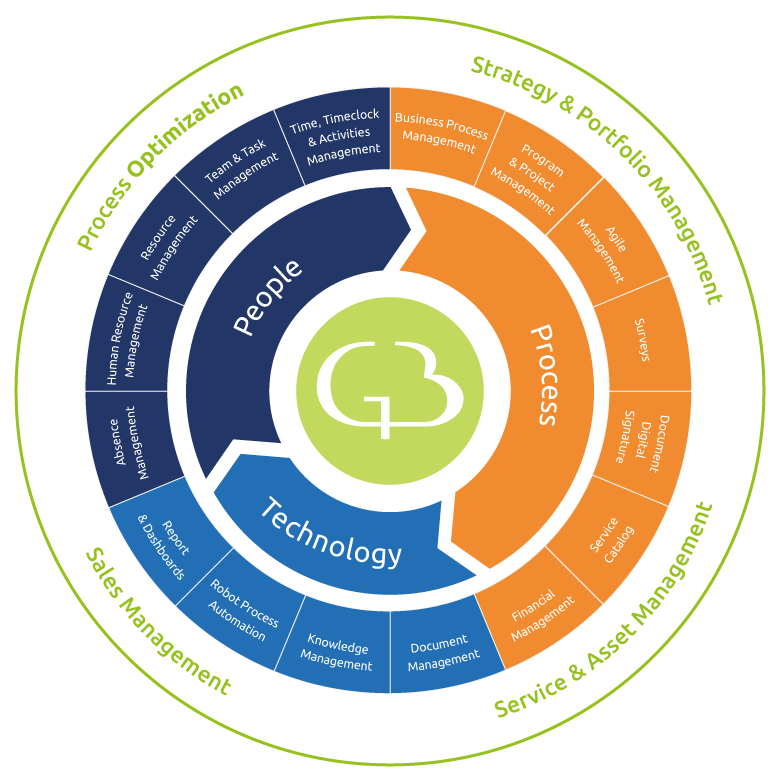
To address these needs, InovaPrime has integrated RPA capabilities into Governance.Business, our BPM and Governance platform. This evolution brings together workflow orchestration and task automation in one place, creating a stronger operating model focused on efficiency, risk reduction, and better decision making.
With Governance.Business RPA capabilities, organizations can:
- Run distributed automations across multiple regions.
- Execute different robots in parallel while keeping governance centralized.
- Orchestrate execution through BPM processes or run automation as a standalone approach.
- Monitor execution in real time with clear visibility and control.
- Trigger tasks through BPM, manual creation, Excel, or other integrations.
This integration supports end-to-end automation. BPM defines and orchestrates the logical flow of processes. RPA executes repetitive tasks such as migrating data between systems, copying and validating information, generating reports, and interacting with multiple applications to complete standard workflows.
In practice, this means clients can scale operations without adding pressure on teams. People focus on higher value activities. Automation handles repetitive execution with reliability and traceability.
Final thought
RPA is not just a way to do the same work faster. When combined with BPM and governance, it becomes a lever to improve operational performance, reduce risk, and create conditions for sustainable growth. It helps organizations modernize how work is done, protects teams from repetitive workload, and builds a stronger foundation for advanced automation and AI.
If we treat automation as a strategic programme with method, governance, and continuous improvement, it stops being a tactical initiative and becomes a strategic capability.
Governance‑led automation, designed to scale.
When RPA is anchored in BPM, ownership, and governance, it evolves from quick wins into a repeatable capability. InovaPrime brings these disciplines together through Governance.Business — helping executive teams modernize operations with control, traceability, and measurable outcomes.
How is your organization structuring automation today to ensure it remains scalable, governed, and aligned with long‑term business objectives?
ONE PLATFORM
We invite you to discover Governance.Business!

It is an end-to-end business management solution. What is it?
Governance.Business is designed to simplify running your organization in a day to day. It provides multiple functionalities that enable you to focus on analyzing, planning, executing, and controlling your business strategy and operations. Click here to discover all the details about our platform or request a demo with our team.